An ALS diagnosis changes every aspect of life, including a family’s financial security.

At a time when Canadians are already feeling the impact of rising living costs and economic uncertainty, people living with ALS and their caregivers often face sudden income loss, growing expenses, and significant caregiving responsibilities. As the disease progresses, families may need to pay for equipment, home modifications, travel to appointments, and other support, all while their ability to earn an income is reduced.

To better understand these challenges, the ALS Society of Canada (ALS Canada) undertook a national study in 2026 to examine the financial and psychosocial burden of ALS on people living with the disease, caregivers, families, and the healthcare system. The findings present the most comprehensive picture of the impact of ALS in Canada in over a decade.

The financial reality of living with ALS

The Burden of ALS study found that the costs of ALS extend far beyond healthcare. Each year ALS creates a $628.2M annual cost burden in Canada, or roughly $157,000 per person living with ALS.

The findings in this study represent a conservative estimate of the burden of ALS on people living with the disease and their families, recognizing that every individual disease journey is unique.

The largest financial impact comes from lost income. As people living with ALS leave the workforce earlier than planned, reduce their hours, or stop working altogether, and caregivers scale back employment to provide care. The study estimates that ALS results in $449.3 million in lost household income each year across Canada, representing an average loss of roughly $112,000 for each person living with ALS.
Caregiving affects employment, income, health, family roles, and future financial security. The average caregiver household income fell by roughly $22,000 from before caregiving to the time of the survey.

89%

of people living with ALS require a non-professional caregiver.

94%

of employed caregivers reported missing work due to caregiving responsibilities.

Nearly half

of caregivers reported spending 30+ hours per week providing ALS-related care and support.

45%

of caregivers sought mental health support because of their caregiving role.

Overall, more than 78% of the total economic burden of ALS is carried by people living with the disease and their families, highlighting the significant financial pressures placed on households impacted by this devastating disease.

I would show up to work and put on a face like everything was fine, and then I would run to my car during lunch break so I could coordinate her {person living with ALS} appointments and make sure support workers showed up on time. I feel like I live a double life. I am just so tired but I can’t afford to quit my job.

An ALS diagnosis can quickly create a household financial crisis, bringing unexpected expenses while often forcing people living with ALS to leave the workforce and causing a sudden loss of income.
Consider your monthly household budget using the budget building tool below.

$
$0 $10,000
$
$0 $2,500
$
$0 $2,000
$
$0 $2,500
$
$0 $5,000
$
$0 $5,000
$
$0 $10,000
Total monthly expenses Based on the amounts above
$8,000
Could you maintain your monthly budget if your household suddenly lost one income?

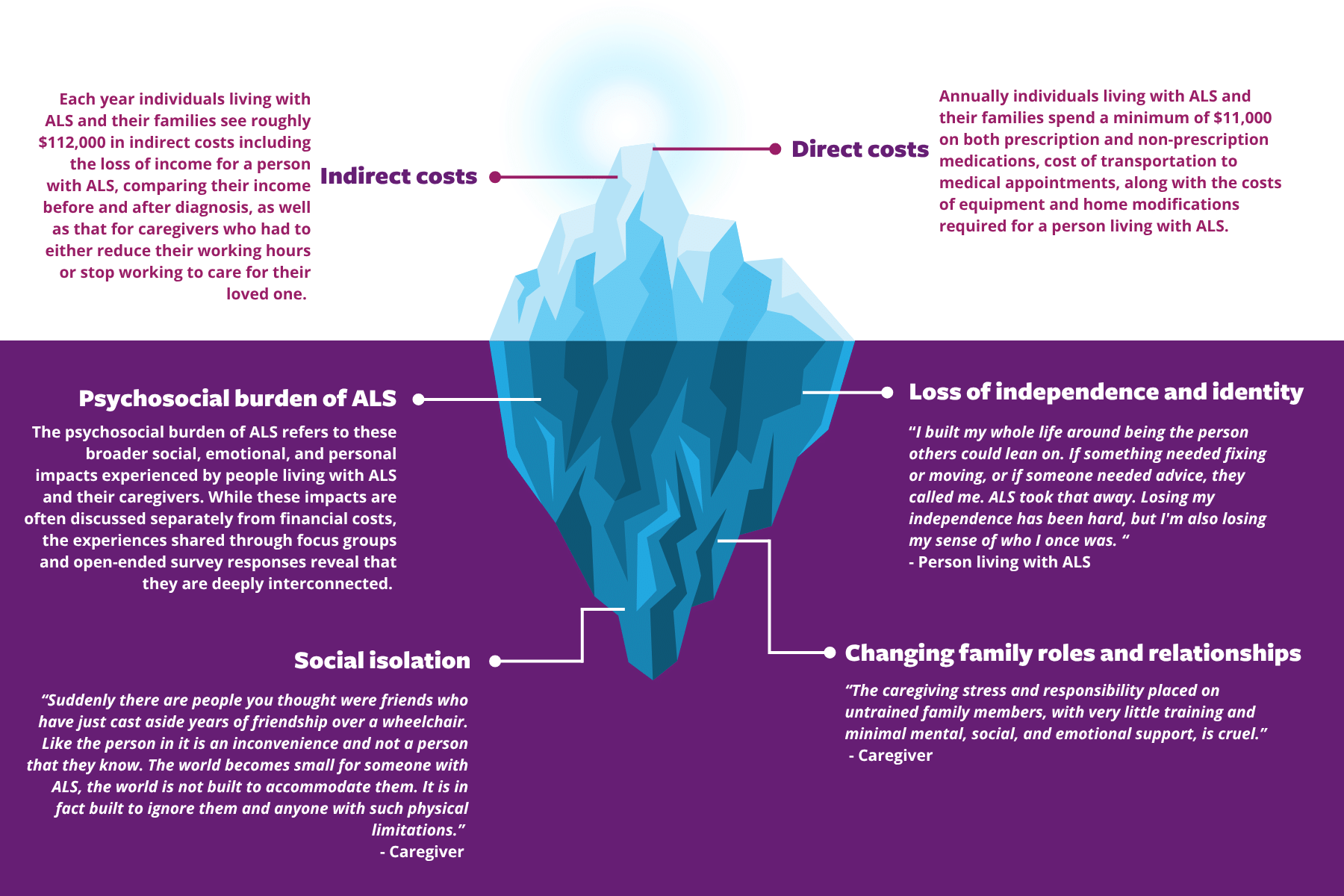
Finances are just the tip of the iceberg: What the psychosocial burden of ALS looks like for Canadian families.

While financial impacts are often the most measurable, ALS affects far more than a family’s finances. As the disease progresses, people living with ALS and their caregivers face profound changes that affect nearly every aspect of daily life – making the psychosocial impacts of ALS among the most challenging aspect of this diagnosis.

Understanding the psychosocial impacts of ALS

Advancing Action on the Burden of ALS

In Canada, ALS can create a profound household-level crisis, affecting financial security, caregiving responsibilities, employment, independence, and quality of life. Although every person living with ALS and their family experiences the disease differently, this study provides an important baseline for understanding and discussing its impact on people living with ALS, caregivers, families, and the broader health system. The figures represent minimum average financial costs and should be interpreted with the recognition that individual experiences vary and that reported expenses may reflect what households could afford or considered essential, rather than the full extent of their needs.

The findings in this report will advance ALS Canada’s advocacy efforts and drive greater awareness among governments, decision-makers and the public of the significant burden of ALS on people living with the disease, their families, and the health system.

Read the Report. Learn why the burden of ALS means far more than healthcare costs alone, placing a significant financial, practical, and psychosocial burden on people living with ALS, caregivers, and healthcare systems across Canada, and emphasizes the need for stronger policies and investments to better reflect the realities of the disease.