As we look back on 2025, we’re proud to highlight the research achievements we accomplished together.
Advancing ALS research is costly, requiring specialized equipment, data analysis, participant recruitment, and highly skilled teams. Yet investment in Canada still falls short of what’s needed to accelerate discoveries at the pace people living with ALS deserve.
That’s why donor support is essential. At ALS Canada, we stretch every dollar to maximize impact and give promising ideas the chance to grow. Your generosity helps push research forward and brings hope to the ALS community, even in a landscape where resources remain limited, ensuring this important work continues.
If you were able to support ALS Canada in 2025, these are some of the ways your contribution made an impact.
In 2025, we were proud to celebrate a remarkable $5.86 million investment in new ALS research by the Canadian Institutes of Health Research (CIHR), awarded to researchers currently or previously supported by the ALS Canada Research Program. For more than 30 years, the ALS Canada Research Program has supported Canadian researchers by investing in early-stage ideas. These initial investments often lay the groundwork for larger follow-on funding, enabling promising projects to scale and evolve into impactful, long-term research efforts.
We congratulate the researchers whose work continues to advance understanding and fuel progress toward new ALS treatments! Read more.
Our momentum continued to grow throughout 2025. By year’s end, the ALS Canada Research Program was actively supporting 36 research projects across the country alongside two international projects.
This support clearly makes an impact, with more than 16 scientific articles published in 2025 from projects, initiatives, and researchers we supported. Each publication represents more than data: it’s a step forward in the collective effort to unravel the complexities of ALS.
Highlights from Canadian contributions supported include:
This is just a snapshot of the research being conducted in Canada, all thanks to your support.
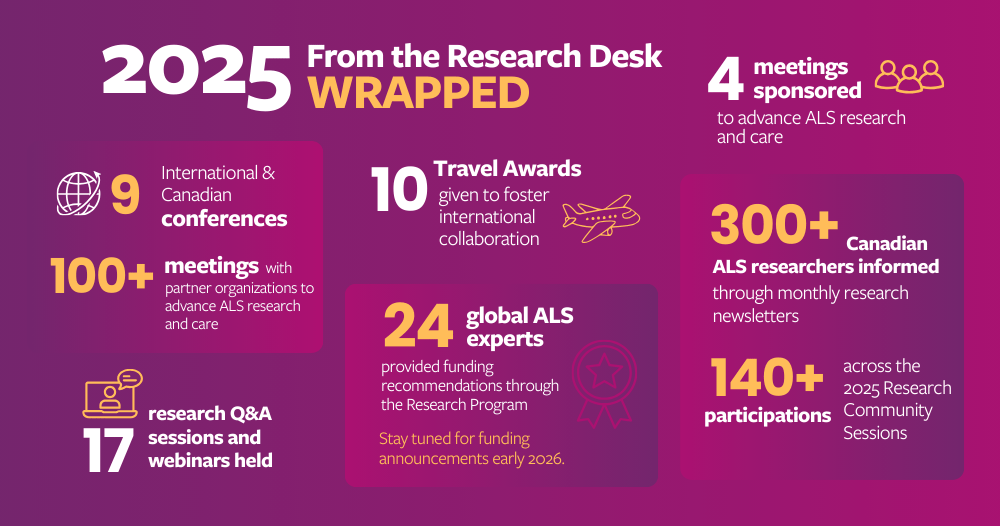
The ALS Canada Research Program is just one way we’re making an impact in the world of ALS research. To discover more about international meetings, partnerships, and contributions, read the latest edition of From the Research Desk:
As we look forward to the future of ALS research, 2026 promises to be a year of continued progress and driving change.
CAPTURE ALS: A New Chapter
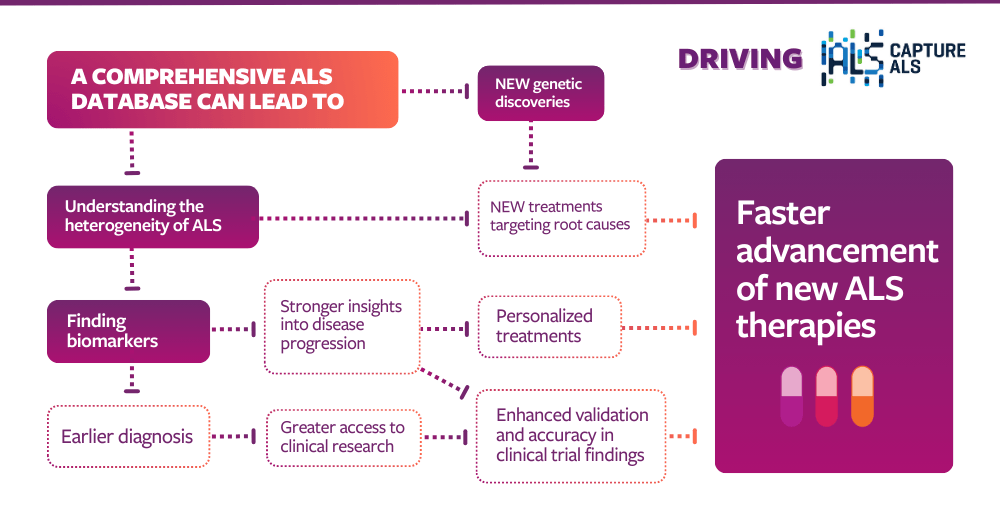
The first cohort of CAPTURE (Comprehensive Analysis Platform To Understand, Remedy, and Eliminate) ALS, Canada’s largest, most comprehensive observational study, is nearly complete. The release of the database is on the way and eagerly anticipated, as it will give researchers the opportunity to analyze the data and uncover new insights.
At the same time, CAPTURE ALS 2.0 is on the horizon.
ALS Canada is proud to support the launch of this expanded cohort, which will allow even more people living with ALS to contribute to research. This next phase will deepen biological insights, strengthen data-sharing, and accelerate discovery.
Canadian Collaboration to Cure ALS
The Canadian ALS community continues to call on the government to invest $50 million over five years in the Canadian Collaboration to Cure ALS, ensuring that no Canadian living with ALS is left behind in research and care.
Last year, people affected by ALS, researchers, clinicians, and ALS organizations across the country, together with ALS Canada, laid the groundwork for the ask. This momentum will continue into the year ahead.
Introducing ALS Advance: National Meetings
In April, ALS Canada will host the inaugural ALS Advance: National Meetings, a coordinated series of meetings focused on improving the lives of Canadians affected by ALS.
The program will bring together researchers, clinicians, early‑career talent, health care professionals, and ALS community members for collaborative learning, candid dialogue, and shared problem‑solving to advance research, care, and knowledge exchange across Canada and globally.
One of the meetings brings something completely new to the field – disrupting it. It marks the first time our doors are fully open to international researchers, strengthening global collaboration for ALS.
Stay connected to find out more.
Strengthening Canada’s Research Ecosystem
In 2026, we are introducing a redesigned Career Transition Award, created to support the next generation of scientific leaders in Canada.
The new model will:
- Allow talented young investigators to apply at any time of year
- Support researchers across various disciplines within basic and clinical sciences in ALS
- Provide modest hiring incentives to retain independent investigators in the ALS field
- Attract new international talent and encourage Canadian researchers abroad to return, maintaining expertise within the country.
The ALS Canada Research Program will also continue its efforts to secure partnerships, build national capacity in ALS research, and support new initiatives that accelerate innovation in the field.
None of this would be possible without the dedication of researchers, the strength of the ALS community, and the generosity of donors.
As we enter 2026, we remain driven by the same purpose: to bring hope to people and families impacted by ALS through research and collaboration.
In our blog series, Driving Discovery, we showcase stories of the ALS Canada Research Program. Thanks to generous donations, our funding has provided foundational support in several areas of ALS research and clinical care.